David Solomon explores the past 500 years of Jewish History, from approximately 1500 to today.
In this talk, David examines each century in detail, looking at:
Sixteenth Century –
Johannes Reuchlin
The printing of the Talmud
Shlomo Molcho and David HaReuveni
Yosef Karo
Moshe Isserles
Azariah de Rossi
Donna Gracia
Suleiman the Magnificent and the land of Israel
The persecution of Marranos
The publication of the Zohar
The Ari
The Maharal of Prague.
Seventeenth Century –
The Council of the Four Lands
The publication of Emeq Hamelekh
The Khmelnytsky massacre
Jewish Amsterdam
Jews under Protestantism
Menasseh ben Israel
Spinoza
Shabtai Zvi and Nathan of Gaza
The Enlightenment
Newton
Leibniz.
Eighteenth Century –
The Shtetl, Berlin and Italy
The Emden/Eubshytz controversy
The Baal Shem Tov
Jacob Frank
The Vilna Gaon
Moses Mendelssohn
Solomon Maimon
The Haskalah
The Aliyot of 1740
The Ramchal, the Or HaChayim, and the RaShaSh
The American and French Revolutions.
The Nineteenth Century –
Rothschild
Napoleon
Emancipation
The rise of “Reform” versus “Orthodoxy”
Chatam Sofer
Samson Raphael Hirsch
Abraham Geiger and Samuel Holdheim
Wissenschaft des Judentums
Montefiore
Jewish America.
The Twentieth Century –
Herzl to the Balfour Declaration
The Aliyot
Eliezer ben Yehudah and the revival of Hebrew
Rav Kook
The Shoah
The establishment State of Israel
Vatican 2
Six-Day War in 1967
The Seventh Lubavitcher Rebbe
Chabad
The Golden Age of Jewish Publishing.
As always, David places Jewish History in the context of world history. He ends this lecture with a discussion on predictions for the future of the Jewish people and the world more broadly.
David Solomon explores the evolution of the messianic idea in Jewish history following the Second Temple era. He examines how circumstances and events propelled transformations in messianic thought. With the Temple’s destruction in 70 CE, David traces the emergence of apocalyptic notions fused to Davidic restoration hopes. He then analyses and contrasts two radically different messianic claimants who arose from this milieu – Jesus of Nazareth and Simeon Bar Kokhba.
Apocalyptic Yearnings in Late Second Temple Times
David emphasises the atmosphere of messianic tension permeating Judea in the late Second Temple period. Oppressive Roman rule prevented fulfilment of biblical redemption prophecies. This spurred apocalyptic thinking – a sense of two worlds, the imperfect present and ideal future. The Dead Sea Scrolls reflect these millenarian hopes for divinely ordained transition to a new cosmic age.
David notes scholarly debate on when eschatological expectations welded onto the Davidic messiah idea. But he argues this fusion clearly occurred by the first century BCE, shaping subsequent movements and claimants. With autonomy lost and foreign domination entrenched, only apocalyptic transformation through divine intervention could realise Jewish sovereignty and freedom.
Jesus of Nazareth – Warrior, Healer, King
This milieu generated numerous messianic figures, with Jesus of Nazareth the most impactful. While historical scepticism exists, David focuses on Jesus’ messianism rather than biographical details. He embodied the diverse facets expected of a redeemer – warrior, healer, and ultimately king of Davidic descent. However, Jesus diverged radically in rejecting violence and earthly power.
David provocatively depicts Jesus as a reform rabbi who challenged the oral law. Through his death, Jesus claimed to fulfil Torah commandments, allowing salvation by faith rather than deeds. But Christianity’s offer of individual salvation clashed with Judaism’s demands for social redemption and justice. This fault line ultimately yielded separation.
Simeon Bar Kokhba – Military Messiah
In 132-135 CE, Simeon Bar Kokhba led a rebellion against Roman rule banned central Jewish practices. With rabbinic backing, he was briefly hailed as Messiah for this defence of Judaism. But his movement’s catastrophic defeat saw him rebranded “Bar Koziba” (Son of Deception). The rabbis determined that militaristic messianic adventurism merely delayed true redemption.
David highlights the vast differences between Jesus’ non-violence and Bar Kokhba’s martial messianism. Yet both emerged from Jewish apocalyptic yearnings in this era.
Arthur Szyk: Bar Kochba, watercolour and gouache on paper, 1927.
The Dual Messiahs – Polarities Reconciled
In the failure of these claimants, David sees the beginnings of the dual messiah concept developed subsequently – Mashiach ben David and Mashiach ben Yosef. This incorporated both perspectives, with the warrior messiah sacrificing himself to enable the Davidic king’s spiritual dominion.
David concludes that the rabbis thereby created a messianic age distinct from the future world to come. While only God can bring the ultimate redemption, our efforts can bridge the present and future by creating the just, peaceful messianic era. This idea of social transformation remains Judaism’s enduring messianic legacy.
Context and Background
To properly understand this lecture, it helps to have familiarity with the basic chronology and themes of Second Temple era Jewish history that David has explored in previous talks. Key events referenced include:
Familiarity with biblical prophecies and Talmudic teachings regarding messianic expectations provides additional useful background. David’s perspective integrates historical analysis with traditional Jewish conceptual frameworks.
Conclusion
Two radically divergent messianic manifestations emerged from the tumultuous circumstances in the late Second Temple era. The many events of this time influenced theological evolution, shaping the Jewish messianic idea as it entered its next phase. Placing Judaism’s messianism within specific historical settings in context reveals its dynamism as an evolving force throughout Jewish history.
This is an AI generated summary of a transcript made of this lecture. If you discover any errors or inconsistencies, please let us know.
The third part of David’s series, Unorthodox Episodes from the Talmud, explores a fascinating series of interconnected stories involving:
a high-level international diplomatic mission,
undercover rabbinical espionage,
a cast of remarkable Talmudic rabbinical figures,
parental concern,
a curious question of Jewish law,
the mystical powers of the rabbis,
a sighting of looted treasures from the temple in Jerusalem,
and a quest to overturn devastating Roman decrees.
David discusses key Talmudic personalities from the first two centuries, including:
Rabbi Shimon Bar Yochai
Rabbi Yossi Ben Halafta
Rabbi Reuben Ben Strobilus
Rabbi Yossi HaGellili
Rabbi Eleizer Ben Yossi
as well as (lehavdil) Ben Tamalia.
He also provides historical context for the events discussed in the Talmudic passages, some of the prevailing cultural and religious norms of the time, and the messages that arise from this unorthodox episode of the Talmud.
Part two of David’s Zoom series, Unorthodox Episodes from the Talmud, mixes Jewish history with textual learning and fascinating storytelling.
The talk continues the story begun in the previous episode regarding Rav Kahana, a third-century sage who fled Babylonian authorities to find refuge in the Land of Israel following a violent confrontation in a rabbinical court.
In this lecture, David describes the next chapter for Rav Kahana following his arrival at the prestigious yeshiva of Tiberius. Through a series of unfortunate actions and misunderstandings, Rav Kahana finds himself once again at the centre of dramatic events involving pride, regret, and death.
As David unravels this extraordinary story, he explores:
key Talmudic figures and their contribution to Jewish life, history, learning, and continuity
the relationships and tensions between some of the great Jewish figures and academies of the time
the political and hierarchical structures of these rabbinical academies
the power of the sages and consequences of unsettling them
how concepts of right and wrong do not always resonate through centuries
the unexpectedly mystical nature of elements of the Talmud.
This lecture places in context the historical situation of the Jewish communities in Babylonia and the Land of Israel. It also reminds us of the importance of Torah scholarship in relation to the shape and influence of different parts of the Jewish world.
In this lecture, David Solomon explores which period of Jewish history most resembles the present age. He emphasises that making meaningful comparisons requires qualifying terms and examining key considerations that shaped each era’s dynamics. David outlines relevant factors regarding geopolitics, governance, land control, exile status, spiritual leadership, and ethical behaviour. By analysing periods against these criteria, one can thoughtfully discuss historical parallels, beyond superficial dinner table assertions.
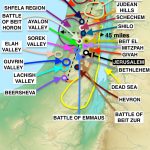
The early victories of the Maccabees over the Seleucid armies have been etched into Jewish memory in the form of the festival of Hanukkah. In this podcast episode, David examines the first four of these Maccabean victories with a focus on the insight, bravery, and military ingenuity of Judea’s guerrilla fighters. Continuing with his exploration of the role played by the geography and topography of the land of Israel in these battles, David offers a rare insight into why, how, and what was involved in these historic events. He also shares his view on the place these victories should take in our historical celebration of the miracle of Hanukkah.
For listeners to the podcast who can not see the maps David draws in this lecture, we have provided a series of graphics in pdf that capture the information provided on the whiteboard. To gain the most from this lecture, we recommend referring to these maps as you listen.
Rough outline of geography & topography of Land of Israel in relation to Maccabean victories. Image created by M Solomon using creative commons map by Sting (see https://commons.wikimedia.org/wiki/File:Israel_relief_location_map-blank.jpg)
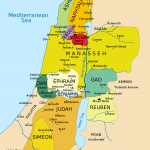
By 12 tribus de Israel.svg: Translated by Kordas12 staemme israels heb.svg: by user:יוסי12 staemme israels.png: by user:Janzderivative work Richardprins (talk) – 12 tribus de Israel.svg12 staemme israels heb.svg12 staemme israels.png, CC BY-SA 3.0, https://commons.wikimedia.org/w/index.php?curid=10865624
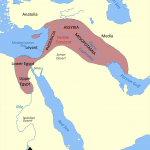
By Nafsadh – Map of fertile cresent.png, CC BY-SA 4.0, https://commons.wikimedia.org/w/index.php?curid=15272124
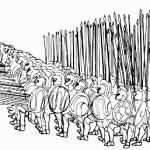
Depiction of a Macedonian phalanx: this graphic was first published in May, Elmer; Stadler, Gerald; Votaw, John; Griess, Thomas (series ed) (1984) Ancient and Medieval Warfare: The History of the Strategies, Tactics, and Leadership of Classical Warfare, New Jersey, United States: Avery Publishing Group. Public Domain.
Released in advance of Chanukah is David Solomon’s exciting exploration of the extraordinary (and miraculous) religious revolt led by the Maccabees between 167 and 160 BCE against the Seleucid Empire – the first installment of a two-part series on the rise and fall of the Hasmonean Dynasty. In this episode, David discusses the key figures of the time and examines the revolutionary military tactics used by Jewish guerrilla fighters to defeat an army that was viewed as invincible.
Bernard Picart: Eleazar’s exploit as described in the Bible. Public domain.
David provides an in-depth discussion of a number of the battles occurring during the period examined in this series. The video below may help listeners gain a clearer picture of the information provided, particularly in relation to the geography and topography of the Land of Israel and how it impacted on military campaigns.
This website uses cookies to improve your experience. We'll assume you're ok with this, but you can opt-out if you wish.AcceptRead More
Privacy & Cookies Policy
Privacy Overview
This website uses cookies to improve your experience while you navigate through the website. Out of these cookies, the cookies that are categorized as necessary are stored on your browser as they are essential for the working of basic functionalities of the website. We also use third-party cookies that help us analyze and understand how you use this website. These cookies will be stored in your browser only with your consent. You also have the option to opt-out of these cookies. But opting out of some of these cookies may have an effect on your browsing experience.
Necessary cookies are absolutely essential for the website to function properly. This category only includes cookies that ensures basic functionalities and security features of the website. These cookies do not store any personal information.
Any cookies that may not be particularly necessary for the website to function and is used specifically to collect user personal data via analytics, ads, other embedded contents are termed as non-necessary cookies. It is mandatory to procure user consent prior to running these cookies on your website.