David Solomon examines Jewish discussions on the death of Titus, the Roman general who presided over the siege in Jerusalem which led to destruction of the Second Temple.
Unsurprisingly, many Jewish commentators throughout history have painted Titus, who followed his father into the role of emperor, in a negative light. However, others claimed that Titus was far from the worst Roman emperor or general for the Jewish people.
In this talk, David explores a Midrash which contends that Titus died from a gnat entering his brain via his nasal passage. This gnat, it suggests, was divine punishment bestowed upon Titus for his wicked behaviour towards the Jewish people.
David examines how this Midrash relates to historical accounts of Titus’ death as well as later discussions on this text. He also discusses kabbalistic ideas concerning this Midrash and the mystical power and purpose of Jewish history for the world.
David Solomon explores the evolution of the messianic idea in Jewish history following the Second Temple era. He examines how circumstances and events propelled transformations in messianic thought. With the Temple’s destruction in 70 CE, David traces the emergence of apocalyptic notions fused to Davidic restoration hopes. He then analyses and contrasts two radically different messianic claimants who arose from this milieu – Jesus of Nazareth and Simeon Bar Kokhba.
Apocalyptic Yearnings in Late Second Temple Times
David emphasises the atmosphere of messianic tension permeating Judea in the late Second Temple period. Oppressive Roman rule prevented fulfilment of biblical redemption prophecies. This spurred apocalyptic thinking – a sense of two worlds, the imperfect present and ideal future. The Dead Sea Scrolls reflect these millenarian hopes for divinely ordained transition to a new cosmic age.
David notes scholarly debate on when eschatological expectations welded onto the Davidic messiah idea. But he argues this fusion clearly occurred by the first century BCE, shaping subsequent movements and claimants. With autonomy lost and foreign domination entrenched, only apocalyptic transformation through divine intervention could realise Jewish sovereignty and freedom.
Jesus of Nazareth – Warrior, Healer, King
This milieu generated numerous messianic figures, with Jesus of Nazareth the most impactful. While historical scepticism exists, David focuses on Jesus’ messianism rather than biographical details. He embodied the diverse facets expected of a redeemer – warrior, healer, and ultimately king of Davidic descent. However, Jesus diverged radically in rejecting violence and earthly power.
David provocatively depicts Jesus as a reform rabbi who challenged the oral law. Through his death, Jesus claimed to fulfil Torah commandments, allowing salvation by faith rather than deeds. But Christianity’s offer of individual salvation clashed with Judaism’s demands for social redemption and justice. This fault line ultimately yielded separation.
Simeon Bar Kokhba – Military Messiah
In 132-135 CE, Simeon Bar Kokhba led a rebellion against Roman rule banned central Jewish practices. With rabbinic backing, he was briefly hailed as Messiah for this defence of Judaism. But his movement’s catastrophic defeat saw him rebranded “Bar Koziba” (Son of Deception). The rabbis determined that militaristic messianic adventurism merely delayed true redemption.
David highlights the vast differences between Jesus’ non-violence and Bar Kokhba’s martial messianism. Yet both emerged from Jewish apocalyptic yearnings in this era.
Arthur Szyk: Bar Kochba, watercolour and gouache on paper, 1927.
The Dual Messiahs – Polarities Reconciled
In the failure of these claimants, David sees the beginnings of the dual messiah concept developed subsequently – Mashiach ben David and Mashiach ben Yosef. This incorporated both perspectives, with the warrior messiah sacrificing himself to enable the Davidic king’s spiritual dominion.
David concludes that the rabbis thereby created a messianic age distinct from the future world to come. While only God can bring the ultimate redemption, our efforts can bridge the present and future by creating the just, peaceful messianic era. This idea of social transformation remains Judaism’s enduring messianic legacy.
Context and Background
To properly understand this lecture, it helps to have familiarity with the basic chronology and themes of Second Temple era Jewish history that David has explored in previous talks. Key events referenced include:
Familiarity with biblical prophecies and Talmudic teachings regarding messianic expectations provides additional useful background. David’s perspective integrates historical analysis with traditional Jewish conceptual frameworks.
Conclusion
Two radically divergent messianic manifestations emerged from the tumultuous circumstances in the late Second Temple era. The many events of this time influenced theological evolution, shaping the Jewish messianic idea as it entered its next phase. Placing Judaism’s messianism within specific historical settings in context reveals its dynamism as an evolving force throughout Jewish history.
This is an AI generated summary of a transcript made of this lecture. If you discover any errors or inconsistencies, please let us know.
The third part of David Solomon’s lecture series, A Kabbalistic Journey Through Time, examines two towering kabbalistic figures of the 16th century.
David explores the ideas of Rabbi Moshe (Moses) Cordovero (the RaMaQ) and Rabbi Yitzchak (Isaac) Luria (the AR”Y), whose contributions to Kabbalah – both emerging in late 1500s in the town of Tzfat – have been seismic.
The lecture investigates the RaMaQ’s book, Pardes Rimonim (The Orchard of Pomegranates), and its exploration of:
rational emanations
ein sof (infinite)
the relationship between Divine influence and the sephirot
the four worlds
the immanence of the Divine in reality
the divine element in the human soul
the revelation of God in meditation, kavannot, and mystical experience.
The AR”Y did not write down his vast kabbalistic teachings. The recording of his ideas was left to his students, chief among whom was Rabbi Chaim Vital. It was Vital who compiled the book Etz Chayim (Tree of Life), the cornerstone text of Lurianic Kabbalah. This book, which was to change forever the landscape of Jewish Mystical thinking, contained many transformative kabbalistic concepts, including:
tzimtzum (contraction)
primordial man (Adam Qadmon)
the domain of chaos (tohu);
shevirah (shattering)
integrated configurations known as ‘partzuphim’
tiqun (repair)
the maintenance and repair of the World of Emanation
the trapped sparks of lower worlds
the five levels of the individual soul
the responsibility of souls to repair the world
David provides an overview of these concepts, a picture of the men from who they emerged, the historical setting of this extraordinary revolution in mystical thinking, and the legacy of these ideas.
David Solomon’s second lecture in his series, A Kabbalistic Journey Through Time, explores the extraordinary ideas and contributions of the:
Zohar,
Tikkunei HaZohar,
and Sefer ha-Temunah.
In his discussion of the Zohar, David examines its dynamic interpretation of the Torah and how it applies this interpretation to the structure of the sefirot. He also looks at the way the Zohar explores the cosmic links between G-d, Israel, creation, and history.
The Tikkunei HaZohar, David explains, is concerned with the Divine presence in the various domains of the universe as well as in exile. Among other things, he considers the Tikkunei HaZohar’s discussion of the feminine Divine presence – the Shekhinah – and Her quest to find unity and completion with Her male counterpart, the blessed Holy One.
The final text David examines is Sefer HaTemunah, which is predominantly concerned with the Divine in time. All things emanate from G-d and return to Him, David explains, and time is divided into cosmic cycles.
In discussing these three important texts, David provides the historical and cultural background to their emergence in Jewish history and their impact on mystical thinking. He also shows his audience the size and presentation of the books and discusses their availability for interested readers – in English, Hebrew, and Aramaic.
This third lecture in David Solomon’s Zoom series, The Power of Change, the Challenge of Teshuva, different ways the Talmud discusses the concept of teshuva.
David explores three illustrative episodes from Tanach and the Talmudic period identified by the sages as:
Examples that teach the importance of teshuva
Halachic guidance in the process of seeking – or bestowing – forgiveness
The importance of self-responsibility in teshuva.
David considers the discussions of the sages in relation to the stories of:
King David
Rav and Mechilah
Elazar bar Dordia.
He also summarises the messages from these episodes and draws them down to their meaning for us as we each consider our actions and failings and come to terms with our individual relationships with teshuva.
This final episode of David Solomon’s series “Unorthodox Episodes of the Talmud” explores the idea of the evil inclination – the yetzer harah – with a particular focus on problems relating to sexual temptation.
The Yetzer Harah
David explains that sages of the Talmud discussed how few things are as powerful as the desire for intimacy. This inclination affects all people, including great spiritual leaders.
Illustrating this point, David examines two stories from the Talmud. The first concerns Rabbi Amrum the Pious, a third-century sage who lived in the Babylonian city of Naharda’ah who fights his evil inclinations. The other looks at a tragi-comic story of Rabbi Hiyya bar Ashi, a student of Rav, who condemned himself in the face of temptation.
Both stories explore moral and ethical considerations concerning intentional, transgression, culpability, and redemption. Other concepts discussed include:
individual and communal shame – both in this world and the world to come
mystical manifestations of evil
the psychology of guilt and self-control
recognition of human failings
the power of sexual urges
whether thinking about a sin carries the same weight as its enactment
moral karma
the importance of remembering and respecting human relationships in our quest to do right
whether suicide is permitted in certain circumstances
the importance of humility
an appreciation that we may each fail when our moral will is tested.
In examining these two unorthodox Talmudic episodes, David discusses the notion that individuals are often tested in line with their unique moral parameters; that we should be wary of placing ourselves on moral pedestals because we may be found wanting; we are all responsible for our behaviour; and that we must know our limitations and our weaknesses.
The third part of David’s series, Unorthodox Episodes from the Talmud, explores a fascinating series of interconnected stories involving:
a high-level international diplomatic mission,
undercover rabbinical espionage,
a cast of remarkable Talmudic rabbinical figures,
parental concern,
a curious question of Jewish law,
the mystical powers of the rabbis,
a sighting of looted treasures from the temple in Jerusalem,
and a quest to overturn devastating Roman decrees.
David discusses key Talmudic personalities from the first two centuries, including:
Rabbi Shimon Bar Yochai
Rabbi Yossi Ben Halafta
Rabbi Reuben Ben Strobilus
Rabbi Yossi HaGellili
Rabbi Eleizer Ben Yossi
as well as (lehavdil) Ben Tamalia.
He also provides historical context for the events discussed in the Talmudic passages, some of the prevailing cultural and religious norms of the time, and the messages that arise from this unorthodox episode of the Talmud.
David Solomon explores the lives, contributions, and circumstances of 14 women from the biblical period of Jewish History. He examines:
Rachav
Devorah
Yael
Bat Yiphtach
Pilegesh Bagiv’ah
Ruth
Channah
Michal
Abigail
Bat Sheva
Jezebel
Ataliah
Yehosheva
Chuldah
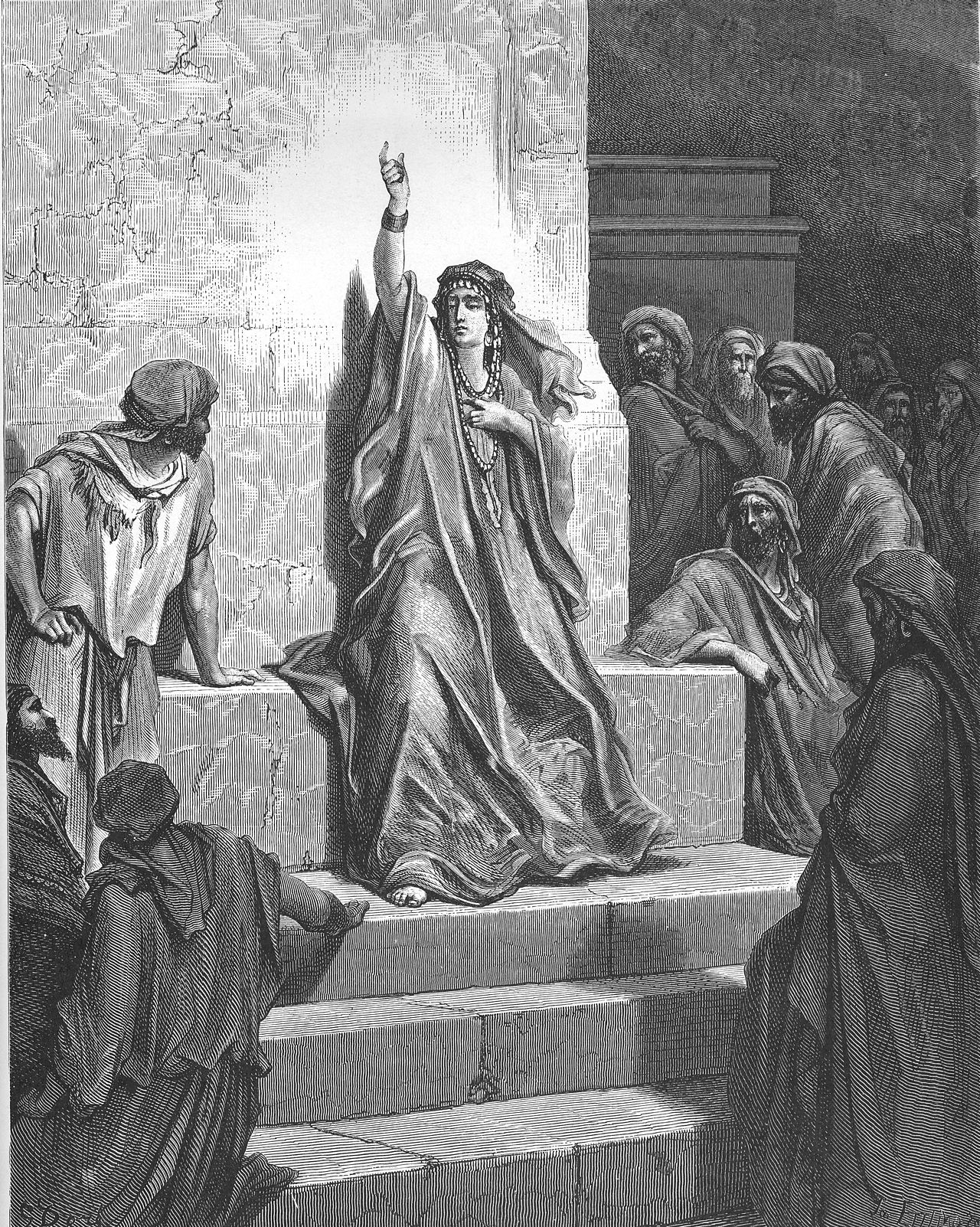
Deborah Praises Jael by Gustave Doré
Among their numbers were:
queens
prophets
judges
politicians
as well as women who were distinguished for their faith, integrity, loyalty, courage, and beauty.
In addition to providing insight into the experiences of these fascinating women, David explains their historical legacies, including:
the preservation of the Davidic line
the cementing of Judaism’s attitude towards celibacy
the power of prayer
the importance of education
women’s connection to Jewish religious practice.
He also traces the changing lot of women throughout the biblical period, from empowerment to disempowerment and back again.
This is the first part of a seven-part series on women in Jewish History David delivered at the Jewish Museum of Australia in 2017. Unfortunately, only some of the talks in the series were successfully recorded. You can find existing lectures by David from that series as well as from others talks on women in Jewish History David has given here:
In this Jewish Philosophy lecture, David Solomon explores the ideas and contributions of four philosophers:
Nachman Krochmal
Hermann Cohen
Franz Rosenzweig, and
Martin Buber
who lived from the late 18th to early 20th centuries.
This post-Enlightenment period saw a movement from reason to existentialism, influenced by Kierkegaard, Kant, and Hegel.
David’s examination of these Jewish philosophers reveals:
Nachman Krochmal and his consideration of the religious versus the good
Hermann Cohen and his emphasis on a return to Jewish sources and the concepts of being and becoming
Franz Rosenzweig and his replacement of Enlightenment universalism with three modes of relationship between the Divine, the world, and humanity – as well as creation, revelation, and redemption
Martin Buber and his exploration of dialogic relationships and expressed in his work “I and Thou.”
In his discussion of these four remarkable thinkers, David provides historical background to Jewish life in Europe – including the impact of emancipation and assimilation – and how this played out in the individual stories of these figures.
This is the seventh talk in David’s eight-part series, A Journey Through Jewish Philosophy, delivered on Zoom for Caulfield Shule in 2020.
The sixth instalment of David’s Jewish Philosophy lecture series considers two renowned, sometimes controversial, philosophers living during the Enlightenment:
In the first part of this Zoom lecture, David examines the ideas and impact of Baruch Spinoza, including the ultimate cause of his excommunication from the Jewish community. He explores concepts developed by Spinoza in his books:
In the first part of this Zoom lecture, David examines the ideas and impact of Baruch Spinoza, including the ultimate cause of his excommunication from the Jewish community. He explores concepts developed by Spinoza in his books:
– Tractatus Theologico–Politicus (Theologico-Political Treatise), which provides a defence of secular thought, and
– Ethics, which discusses:
reality is God
the universe (God) is necessary and determined
miracles do not exist
there is no free will
the pursuit of reason leads to freedom.
For Moses Mendelssohn, David explains, the challenge was to reveal religion in the Age of Reason. Mendelssohn’s book, Jerusalem, explores:
the Torah as revealed law
differences in nature and the laws of the Jewish people
reason as the true religion of humanity
the test of religious truth and its effect on conduct.
As with previous lectures, David provides historical context for both philosophers, describing their 17th and 18th century worlds. He also tackles some of the beliefs and misconceptions about these figures, many of which have carried through to today.
This website uses cookies to improve your experience. We'll assume you're ok with this, but you can opt-out if you wish.AcceptRead More
Privacy & Cookies Policy
Privacy Overview
This website uses cookies to improve your experience while you navigate through the website. Out of these cookies, the cookies that are categorized as necessary are stored on your browser as they are essential for the working of basic functionalities of the website. We also use third-party cookies that help us analyze and understand how you use this website. These cookies will be stored in your browser only with your consent. You also have the option to opt-out of these cookies. But opting out of some of these cookies may have an effect on your browsing experience.
Necessary cookies are absolutely essential for the website to function properly. This category only includes cookies that ensures basic functionalities and security features of the website. These cookies do not store any personal information.
Any cookies that may not be particularly necessary for the website to function and is used specifically to collect user personal data via analytics, ads, other embedded contents are termed as non-necessary cookies. It is mandatory to procure user consent prior to running these cookies on your website.