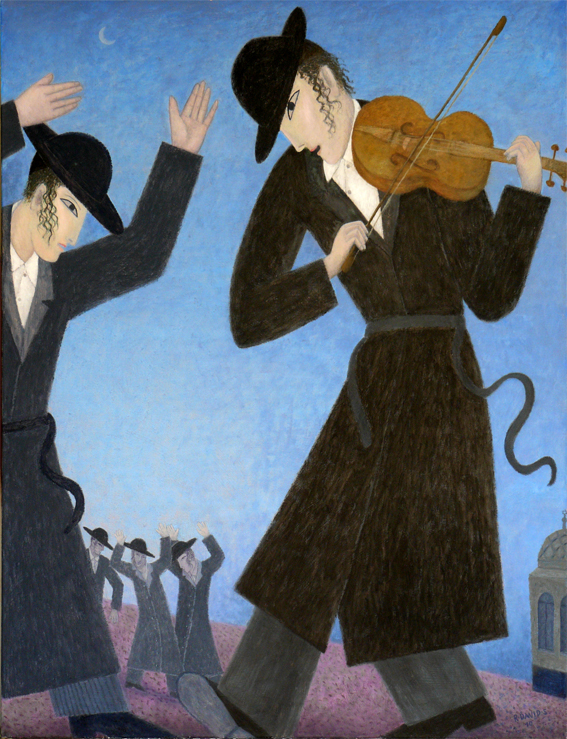
Arising in the wake of a number of dramatic historical events of the 17th century, the Chassidic movement emerged in the first half of the 18th century under the charismatic leadership of Rabbi Israel ben Eliezer, the Baal Shem Tov, with profound effect on European Jewry. In this podcast episode, David Solomon provides an introduction and overview of Chassidism, looking at its early leaders and their ideas. David also examines the impact of the movement, how it has evolved, and the form it has come to take in the current age.
Painting by Roger David Servais – Hasidic jewish fiddler, Homage to Daniel Ahaviel, 100 cm x 130 cm, oil on canvas, 2010, R. David S.pai. Creative Commons.
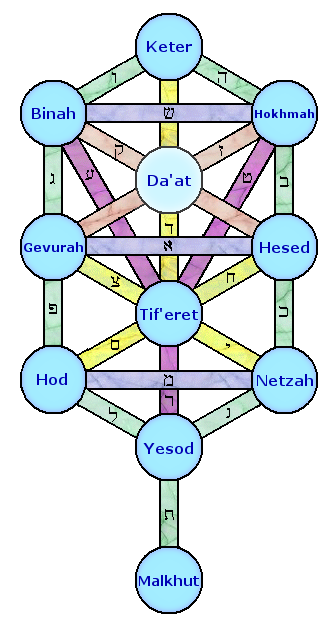
De-mystifing the mystical: in this podcast episode David Solomon explores the complex and profound field of Kabbalah to provide an overview of its texts and ideas, together with their historical background. David also explains exactly where popular Kabbalah comes from and provides the one thing that it is missing: context.
Image by Eliak: Version of the Tree of Life based on that which appears in the Bahir, but with the Sephiroth labelled with Latin letters, and showing both Keter and Da’ath (properly, only one would be shown, and the number of Sephiroth would therefore be ten). Public Domain.
The beginnings of community and the rise of independent colonies are the underpinning themes of this podcast episode, the second of David Solomon’s four-part series on Australian Jewish History. In this episode, David examines a period of 22 years, between 1828 and 1850. He looks at the impact of Jewish free settlers with means and ideas on the new colonies of New South Wales, Victoria and Tasmania, and the emerging Jewish communities within these colonies. David also provides a fascinating insight into a selection of influential and notorious characters whose reputations and contributions loomed large in the new settlements.
Melbourne Hebrew Congregation, Shearith Yisroel, Remnant of Israel, Bourke St West Congregation. Watercolour from an illuminated address presented by the Victorian Jewish Community to Sir Benjamin Benjamin, Lord Mayor of Melbourne, in honour of his Knighthood in 1889. Publisher: Valentine Sands, Melbourne. Flickr. Creative Commons.
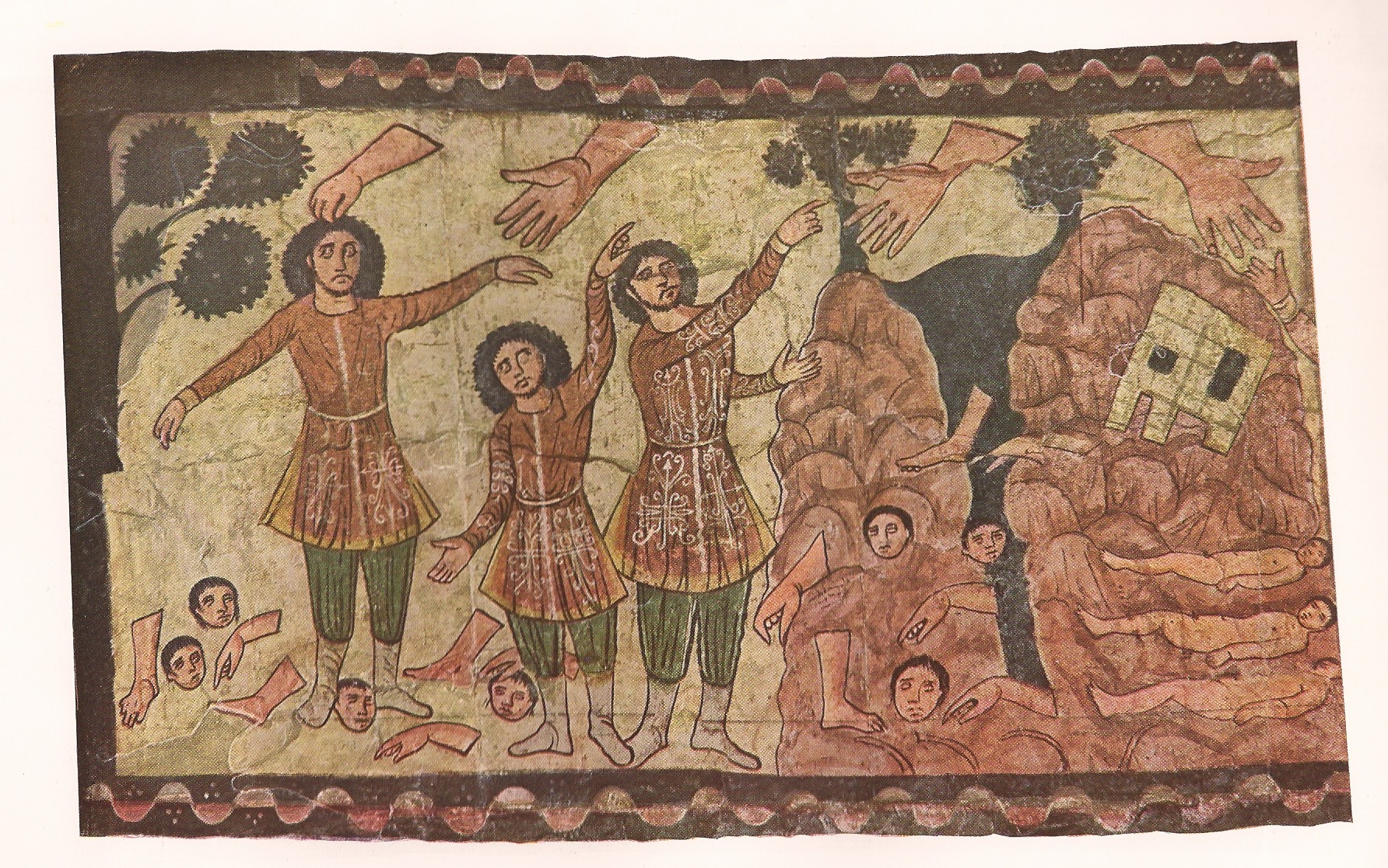
From deep within the Babylonian exile, the prophet Ezekiel became the extraordinary conduit for the voice of Gd outside of the Land of Israel. In this podcast episode, David Solomon explores the life and setting of the prophet Ezekiel; his profound messages of teshuva and the importance of individual responsibility; and his remarkable visions – including those of the divine chariot, the Temple, and the valley of the dry bones – which have been a source of fascination and controversy for two and a half thousand years.
Ezekiel and the hand of God. Dura Europos synagogue wall painting. Public Domain.
The prophets of Israel emerged into history with positions and authority unprecedented across the ancient world. In this podcast episode, the first of a four-part series on the rise of the prophets of Israel, David Solomon examines this extraordinary social and spiritual phenomenon. Providing comprehensive historical background to the societies into which these prophets emerged, he explores the beginnings of literary prophecy through the extraordinary lives and inspiring words of the early prophets, Amos and Hoshea.
The Prophet Hoshea and his wife Gomer. Public Domain.
Scholars, doctors and adventurers are the focus of this podcast episode, the final talk in David Solomon’s series on the 16th century. David explores figures of the second half of the 1500s, from Europe to the Americas, who made extraordinary contributions in science and medicine, mysticism and rabbinic literature, commerce and politics, and global exploration. These remarkable people and their works influenced contemporary and future Jewish life and helped shape the world that was to emerge in the following century.
Marranos: Secret Seder in Spain during the times of inquisition, an 1892 painting by Moshe Maimon. Public Domain.
In the first of this podcast series looking at Jewish History of the 16th century, David Solomon examines fascinating religious and secular developments of the early 1500s in Europe and Asia and the consequences they would have for Jewish populations – both positive and negative. David also discusses the emergence of a range of remarkable Jewish figures during this period as well as influential new texts in Jewish mysticism, history, law and commentary, and science – and an explosion in the printing of Jewish books which would have significant impact on the spread of learning and ideas across the world.
“Göke” (1495) was the flagship of Kemal Reis to save the Sephardic Jews of Spain from the Spanish Inquisition and granted them permission to settle in the Ottoman Empire. Public Domain
Throughout Europe, Jewish life in the second half of the 13th century existed under economic and theological oppression. There were national expulsions; country-wide promotions of the blood libel; sermons to convert Jews; papal bulls; forced disputations; massacres; and organised kidnappings. However, this fifty-year period also saw profoundly important developments in Jewish mysticism, law and commentary. Surroundings these elements are the fascinating stories of individuals and communities whose lives and works shaped the Jewish narrative of the future as well as the broader world.
Rembrandt: Philosopher in Meditation. Public Domain
The second half of the 12th century is the focus of this podcast episode. David Solomon explores Jewish History through the eyes and contributions of individuals and the broader perspectives of nations. He examines the life and work of towering figures like the Rambam (Maimonides), the significant contributions made by Torah commentators and translators of the period, the observations of a famed Jewish traveller, the rise of a new mystical movement, and the impact of a false messiah. The podcast also discusses the ongoing consequences of the crusader campaigns, the regeneration of Jewish communities in Germany, Jewish life in Bagdad, the establishment of a Jewish presence in China, the forced conversion of the Jews of Yemen, and the consequence of the Third Lateran Council on the status of Jews in the Middle Ages.
Maimonides teaches about the ‘measure of men’ (compared to the earth and the universe, men is very small). Public domain image.
The period of the Josianic kings, from Menasheh to Zedekiah, was the last chapter for the Judean Kingdom before the Babylonian exile. This podcast explores the personalities and actions of these kings and the overall historical setting of their reigns, including the domination and fall of the Assyrian Empire, the defeat of Egypt, and the rise and supremacy of Babylon. David looks at the lead up to the destruction of the Temple, the Babylonian exile, the return to Zion and the project to rebuild the Temple in Jerusalem.
James Tissot – The Flight of the Prisoners [Public domain]
This website uses cookies to improve your experience. We'll assume you're ok with this, but you can opt-out if you wish.AcceptRead More
Privacy & Cookies Policy
Privacy Overview
This website uses cookies to improve your experience while you navigate through the website. Out of these cookies, the cookies that are categorized as necessary are stored on your browser as they are essential for the working of basic functionalities of the website. We also use third-party cookies that help us analyze and understand how you use this website. These cookies will be stored in your browser only with your consent. You also have the option to opt-out of these cookies. But opting out of some of these cookies may have an effect on your browsing experience.
Necessary cookies are absolutely essential for the website to function properly. This category only includes cookies that ensures basic functionalities and security features of the website. These cookies do not store any personal information.
Any cookies that may not be particularly necessary for the website to function and is used specifically to collect user personal data via analytics, ads, other embedded contents are termed as non-necessary cookies. It is mandatory to procure user consent prior to running these cookies on your website.